
Silicone elastomer gel can make or break the sensory profile of a premium foundation or serum, yet many formulators discover documentation gaps only after the formula is locked. Late findings stall launches and force costly reformulation. I treat document review as part of material selection, so the paperwork and the sensory targets move forward together.
You should review the technical data sheet, the safety data sheet1, the certificate of analysis2, and the INCI and composition information for the exact silicone elastomer gel grade, then map those documents against the destination market's registration rules, your intended application, and your duties as the market authorization holder. No single supplier document alone proves market access.

Below, I break the review into the parts that matter in daily sourcing work: market context, the four core documents, grade-level detail, application fit, the halal question, and the supplier workflow. Each section ends with a takeaway you can apply to your next purchase.
Why Does the Target Market Shape Your Documentation Checklist?
Two buyers once asked me about the same gel grade within one week. The first sold finished products in a single market. The second planned a launch across several regions. Their document needs looked nothing alike. When buyers skip this question, they either over-collect papers or miss the one file that matters.
The destination market decides who carries compliance responsibility, what ingredient information regulators expect, and which files retail customers request. Before I propose any grade, I ask four intake questions: destination market, finished product type, formulation system, and target skin feel. Those four answers define the scope of every document that follows.

Different regulatory regimes distribute responsibility in different ways. A European-style framework places duties on a named responsible person3 for each product placed on the market. The modernized United States framework4 puts clear obligations on brand owners and manufacturing facilities. Several Asian markets operate notification-based systems where the local importer or distributor registers the product. These regimes differ in detail, but they share one trait: the compliance duty sits with the company that places the finished product on the market, not with the raw material supplier.
This division of responsibility shapes how I read documents. A supplier file describes the material. It does not decide whether your finished formula meets the destination rules. That decision belongs to your regulatory team or to you as the market authorization holder.
The first question is never "which certificates do you hold?" It is "where will this product be sold, and who signs the notification?"
I run four intake questions before any grade proposal:
- Destination market. This answer sets the applicable regime, the notification route, and any market-specific file requests from retailers.
- Finished product type. A rinse-off cleanser, a leave-on serum, and a color cosmetic attract different safety margins and claim rules.
- Formulation system. The oil phase, the emulsion type, the powder load, and the packaging constrain which carrier and loading will work.
- Target skin feel. Slip, cushion, blurring, and after-feel point toward different gel families.
Early in my career, I once chased a long list of documents for a client who later revealed that the launch market required none of them. The wasted effort taught me a simple rule: ask first, collect second. I am not a regulatory authority, and frameworks change, so treat the regimes above as orientation and verify current requirements with qualified advisors.
Which Four Documents Form the Core Review Set for a Silicone Elastomer Gel?
Many sourcing teams collect certificates the way travelers collect boarding passes. The folder grows thick, yet the sheet matching the actual purchase order is missing. I have opened more than one file where every document referenced a different grade.
Review four documents and treat each by its function. The technical data sheet screens performance. The safety data sheet covers safe handling. The certificate of analysis confirms batch-specific results. The INCI and composition information supports ingredient declaration and formulation review. None of these documents alone proves market access.
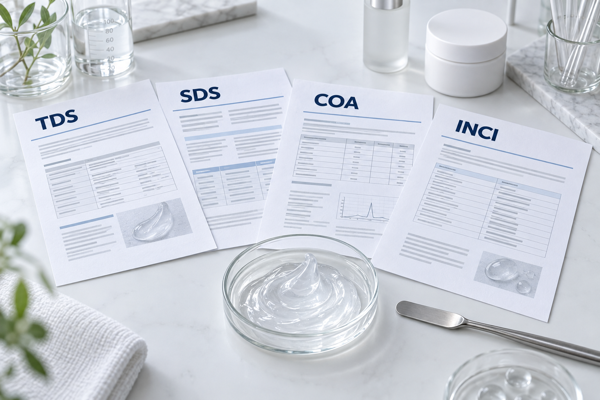
Each document in the core set performs one job. Problems appear when a buyer expects one sheet to do another sheet's work. The table below shows how I separate the functions.
| Document | Primary function | What to verify | What it does not do |
|---|---|---|---|
| TDS | Performance screening | Grade name, carrier, non-volatile content5, viscosity | Confirm regulatory status |
| SDS | Safe handling and storage | Revision date, grade match, hazard classification | Prove finished-product safety |
| COA | Batch conformance | Lot number, results versus specification | Replace a full dossier |
| INCI / composition | Labeling and formulation review | Naming, carrier, composition statement | Make two grades interchangeable |
Technical data sheet: the performance screen
The TDS for a silicone elastomer gel should state the grade designation, the carrier, the non-volatile content (often read as elastomer loading), and the viscosity, together with the test methods used. These parameters drive screening. A primer formula may need a high loading for a blurring finish, while a light serum may need a lower-viscosity, lower-loading option.
Safety data sheet: the handling document
The SDS supports safe storage, handling, and transport of the raw material as shipped. It does not replace a finished-product safety assessment. Check the revision date, and confirm that the SDS references the same grade you sampled.
Certificate of analysis: the batch link
The COA ties test results to one specific lot. I ask buyers to compare the COA lot number against the sample they actually evaluated. A COA from a lot produced two years ago tells you little about the drum you will receive next month.
INCI and composition: the labeling base
The INCI listing supports ingredient declaration on the finished package. The composition statement helps formulators see the carrier and the crosspolymer identity. It does not make two commercial grades interchangeable.
A buyer once presented a full folder with real pride. Every certificate was genuine. However, none of the documents referenced the grade in the sample jars on his desk. We rebuilt the file in one afternoon, and the project lost no further time.
Why Does the Exact Grade Matter More Than the INCI Name?
A distributor once forwarded a shared INCI name and asked whether two silicone elastomer gels could replace each other directly. The paperwork suggested yes. The trial results said otherwise. Apparent equivalents still require formulation, stability, and sensory testing.
An INCI name identifies a chemistry family for labeling purposes. It does not describe the full commercial identity of the material. Two silicone elastomer gel grades can share one INCI name and still differ in crosspolymer loading, carrier, viscosity, and final sensory behavior6.
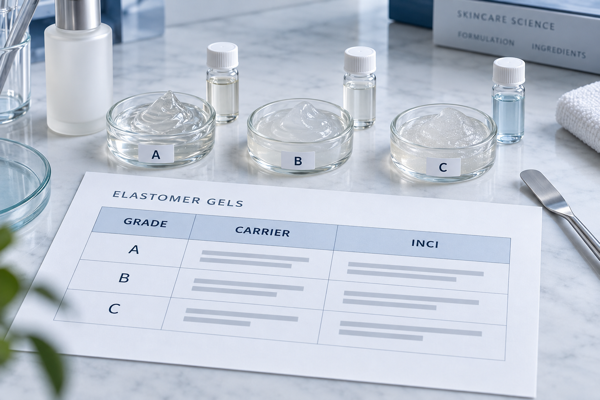
The INCI system7 exists so that consumers and regulators can read one consistent ingredient name on every label. It was never designed to specify a commercial product. When I compare grades, I read the INCI name first and the specification second, because the specification carries the information that affects your formula.
| Attribute | INCI name | Grade specification |
|---|---|---|
| Chemistry family of the crosspolymer | Yes | Yes |
| Carrier identity | Sometimes | Yes, exactly |
| Elastomer loading / non-volatile content | No | Yes, with limits |
| Viscosity range | No | Yes, with method |
| Sensory behavior | No | Suggested, then confirmed by trials |
| Batch specification | No | Yes |
Consider a common situation. Two grades can share a listing where a crosspolymer is dispersed in dimethicone. One disperses the crosspolymer at a low level in a lightweight carrier. The other delivers a high loading in a heavier carrier. On the label, the two products look similar. In a cushion compact, one gives a dry, velvet finish, and the other gives slip that fights payoff.
A formulator once replaced a benchmark silicone elastomer gel with a name-matched equivalent and found tack in a primer within weeks. The fix required a lower loading and a powder adjustment. In other words, the swap demanded real formulation work, not a like-for-like substitution.
A matching INCI name is the beginning of a comparison, never the end of one.
My grade-level checklist before any replacement looks like this:
- Compare the carrier, the non-volatile content, and the viscosity side by side.
- Request the TDS method notes, because laboratories measure viscosity under different conditions.
- Run your own sensory panel against the benchmark material.
- Repeat stability and compatibility tests before the swap, not after a market complaint.
How Do You Match Documentation to Your Formulation System and Application?
A cushion compact and a lightweight serum once came from the same brand team. Both teams wanted the same gel grade for simplicity. The serum passed all checks. The compact lost payoff within weeks. Application context, not habit, should drive the choice.
Match the document set to the formula that will receive the material. Check the carrier against your oil phase, the non-volatile content against your target loading, and the viscosity data against your process limits. Then confirm stability and compatibility through your own testing program.

I rarely begin a gel conversation with documents. I begin with skin feel, because documents describe averages while formulas live in specifics. My working sequence looks like this:
- Define the sensory brief. The brand states slip, cushion, blurring, and after-feel targets in plain words.
- Define the formulation conditions. We record the oil phase, the emulsion type, the powder load, and the process limits.
- Shortlist grades. I propose grades whose carrier and loading suit those conditions.
- Run small trials. The lab tests at two or three loadings and adjusts combinations with other silicones or powders.
- Align the documents. Only then do we lock the document set to the chosen grade.
The carrier deserves special attention. A silicone elastomer gel carried in a volatile fluid behaves differently in an anhydrous system than in an emulsion8. The non-volatile content sets the practical loading window, because performance scales with use level, but so do cost and tack. Powder interaction matters most in color cosmetics, where elastomers change dispersion and payoff9. Process viscosity sets hard limits, because filling lines and homogenization equipment tolerate only certain ranges.
A primer project illustrates the point. The brief said "velvet blur without slip." The team tested three loadings of the same grade before the panel agreed on one. The document review then took a single day, because the grade, the lot, and the formula had already converged.
Sensory evaluation remains subjective10, so I recommend a fixed panel and a benchmark sample in every trial. Stability and compatibility tests close the loop, because gel behavior can shift over time in complex systems. Documents support these decisions; they never replace them.
Is Halal Documentation Required for a Silicone Elastomer Gel?
A brand team preparing a Southeast Asia launch11 once asked me whether halal files were mandatory for every cosmetic raw material. I could not answer with a blanket yes or no. The honest answer depends on the market, the channel, and the customer.
Halal documentation is not a universal requirement for cosmetic ingredients. It becomes relevant when the destination market, the sales channel, the retailer, or your end customer requires it. In those cases, verify the current local requirement, the certification body, the certification scope, and the validity period.

I field the halal question often, and the safest honest answer is that it depends. Halal documentation is market-specific, channel-specific, and customer-specific rather than universal.
The requirement tends to matter when:
- The destination market or a retailer requires halal-marked cosmetics.
- A customer contract or a channel specification demands it.
- The finished product carries a halal claim on its label.
The requirement tends not to matter when the market has no such rule, or when the material serves industrial use without any consumer halal claim.
When the requirement does apply, I guide buyers through four checks:
- Certification scope. The document should cover the specific grade and the manufacturing site, not just the company name.
- Issuing body. Recognition of certification bodies varies by destination market, so the buyer confirms acceptance locally.
- Validity and version. Check the expiry date, and match the document to the current grade and lot.
- Current local requirements. Rules evolve, so verify the requirement against up-to-date local sources before each launch.
I supply materials and application support. I do not certify markets. Treat halal files as market-specific evidence to verify, not as a default attachment to every shipment.
One Southeast Asia launch I supported required halal-marked products, so the brand drove the requirement down to every ingredient file. Another project in the same region never faced the question, because no channel asked. Same region, different answers. That contrast explains why I refuse to give a blanket rule.
How Should You Structure a Documentation Review With Your Silicone Elastomer Gel Supplier?
I once watched a project lose three weeks because documents arrived in scattered emails over a month. The grade was fine. The process was not. Structure prevents that kind of loss, and structure costs almost nothing.
Structure the review in five stages: confirm use, market, and performance targets; request the document set for the exact silicone elastomer gel grade; verify versions against your sample lot; run formulation and sensory trials; and record everything in a supplier qualification file12 before volume orders.

Scattered emails create most documentation delays, not missing paperwork. A fixed sequence solves the problem. Here is the process I run with buyers:
- Confirm use and targets. We record the market, the product type, the formulation system, the skin-feel target, and the indicative volume.
- Request the grade-specific document set. The set covers the TDS, the SDS, the INCI and composition information, and the COA for the sample lot.
- Verify version alignment. We match grade names and lot numbers across the documents and the physical samples.
- Evaluate in the formulation. The buyer runs sensory, stability, and compatibility trials, ideally at two loadings.
- Build the qualification file. We record results, document versions, contacts, and the agreed specification before any volume order.
The qualification file itself should contain:
- The grade designation and the TDS version
- The SDS revision date
- The COA for each sample lot
- The INCI and composition statement
- The trial records and sensory results
- Any market-specific files, verified by the buyer's regulatory team
- The agreed specification for ongoing supply
The file also supports ongoing supply. Each commercial batch should arrive with a matching COA. When a supplier updates a TDS or an SDS version, that change should be flagged, and the buyer should decide whether re-verification is needed.
I keep one honest boundary in these discussions. I can tell you which documents exist for a grade and what those documents say. I cannot promise a fixed certificate list in advance, because availability depends on the exact grade and the document version. We confirm those details during evaluation, grade by grade.
Frequently Asked Questions
Does a matching INCI name make two silicone elastomer gel grades interchangeable?
No. The INCI name supports ingredient declaration, while the grade specification defines the carrier, the elastomer loading, and the viscosity. Apparent equivalents still require formulation, stability, and sensory testing in your own system before any substitution.
Is a certificate of analysis the same as a regulatory approval?
No. A COA confirms that a specific batch meets the supplier's specification. It does not grant market access or replace the regulatory work of the market authorization holder. Verify what each document covers before relying on it.
Can the supplier's SDS prove my finished product is compliant?
No. An SDS addresses safe handling, storage, and transport of the raw material. Finished-product safety and compliance depend on the complete formula and remain the responsibility of the brand or the market authorization holder.
Do all markets require halal documentation for cosmetic ingredients?
No. Halal documentation is market-, channel-, and customer-specific rather than universal. When a destination market or retailer requires it, verify the current local requirement, the certification scope, and the validity for the exact grade.
What should I do if the documents do not match my sample batch?
Request the documents issued for the exact grade and lot you are testing. Version mismatches are common when suppliers update specifications. Match document versions to sample lots before you draw conclusions from any test result.
Conclusion
Documentation review for a silicone elastomer gel is a risk-based selection process, not a certificate hunt. Start from the destination market, the finished product, the formulation system, and the target skin feel. Check the TDS, the SDS, the COA, and the INCI information for the exact grade. Treat halal files as market-specific requirements you verify yourself. My team at Ruihe New Materials supplies silicone elastomer gel grades such as RH-5601 and RH-5602, and we support selection, samples, and grade-specific documentation during evaluation. Share your market, your formula, and your sensory targets, and we will review the fit together.
"1910.1200 - Hazard Communication. | Occupational Safety ...", http://www.osha.gov/laws-regs/regulations/standardnumber/1910/1910.1200. United States Occupational Safety and Health Administration (OSHA), 29 CFR 1910.1200 Hazard Communication Standard; see also Regulation (EC) No 1223/2009, Article 10 and Annex I on cosmetic safety reports. Evidence role: definition; source type: government. Supports: Safety Data Sheets adhere to occupational hazard communication standards (e.g., GHS/OSHA) and do not evaluate systemic exposure or toxicological safety margins required for consumer cosmetic products.. ↩
"GMP Guidelines/Inspection Checklist for Cosmetics", https://www.fda.gov/cosmetics/cosmetics-guidance-documents/good-manufacturing-practice-gmp-guidelinesinspection-checklist-cosmetics. International Organization for Standardization, ISO 22716:2007: Cosmetics — Good Manufacturing Practices (GMP) — Guidelines on Good Manufacturing Practices, Section 6.5. Evidence role: definition; source type: institution. Supports: Under Good Manufacturing Practice (GMP) guidelines, a Certificate of Analysis is recognized as lot-specific documentation verifying that chemical parameters comply with agreed acceptance limits.. ↩
"The Responsible Person – Cosmetics Regulation 1223/2009", https://www.ecosistant.eu/en/the-responsible-person-role-under-the-cosmetics-regulation-1223-2009/. Regulation (EC) No 1223/2009 of the European Parliament and of the Council, Chapter II, Article 4, defines the statutory obligations and liability of the designated Responsible Person. Evidence role: definition; source type: government. Supports: European Union cosmetic regulations mandate that a designated responsible person ensure compliance with safety, notification, and dossier requirements prior to commercial release.. ↩
"Modernization of Cosmetics Regulation Act of 2022 (MoCRA)", https://www.fda.gov/cosmetics/cosmetics-laws-regulations/modernization-cosmetics-regulation-act-2022-mocra. Modernization of Cosmetics Regulation Act of 2022, Public Law 117-328, Subtitle E, 136 Stat. 5569 (codified at 21 U.S.C. 364 et seq.). Evidence role: historical_context; source type: government. Supports: The Modernization of Cosmetics Regulation Act of 2022 (MoCRA) expanded FDA authority by requiring facility registration, product listing, and adverse event reporting for responsible persons.. ↩
"Determination of cyclic volatile methylsiloxanes in personal ...", https://pubmed.ncbi.nlm.nih.gov/28699157/. Standard Test Method for Nonvolatile Content of Resin Solutions, ASTM D1259 / ISO 3251 (Paints, varnishes and plastics — Determination of non-volatile-matter content). Evidence role: mechanism; source type: paper. Supports: Gravimetric measurement of non-volatile matter after thermal conditioning serves as standard laboratory methodology for determining polymer solids dispersed in volatile carriers.. Scope note: The test measures total non-volatile residue by mass and does not directly differentiate crosspolymer structures from non-volatile carrier co-solvents. ↩
"Safety Assessment of Dimethicone Crosspolymers as Used ...", https://pubmed.ncbi.nlm.nih.gov/24861370/. Lin, Z., et al., 'Rheology and microstructure of cross-linked silicone elastomer gels,' Journal of Colloid and Interface Science, vol. 274, no. 1, pp. 107–114, 2004. Evidence role: mechanism; source type: paper. Supports: Rheological characterization shows that the swelling degree of silicone crosspolymers and carrier fluid viscosity dictate shear thinning, yield stress, and sensory texture across materials sharing the same INCI designation.. Scope note: Studies generally test defined synthetic model systems rather than proprietary commercial blends across all silicone polymer varieties. ↩
"Cosmetics Labeling Guide", https://www.fda.gov/cosmetics/cosmetics-labeling-regulations/cosmetics-labeling-guide. Personal Care Products Council (PCPC), 'INCI Application Process and General Principles of INCI Nomenclature,' International Cosmetic Ingredient Nomenclature Committee. Evidence role: definition; source type: institution. Supports: The INCI program assigns standardized nomenclature for ingredient labeling purposes and explicitly does not establish chemical specifications, grades, or performance standards.. ↩
"A comparison between silicone‐free and silicone‐based ...", https://pmc.ncbi.nlm.nih.gov/articles/PMC9545630/. Wiesman, C., and Dayan, N., 'Volatile silicones in cosmetic formulations: Evaporation kinetics and matrix effects,' International Journal of Cosmetic Science, vol. 35, no. 4, pp. 382–389, 2013. Evidence role: mechanism; source type: paper. Supports: Thermodynamic activity and phase partitioning in emulsion systems retard volatile carrier evaporation compared to pure solvent or anhydrous oil systems.. ↩
"Silicone in Dermatology: An Update - PMC - NIH", https://pmc.ncbi.nlm.nih.gov/articles/PMC10298615/. Tadros, T. F., 'Application of rheology in cosmetic formulations and pigment suspensions,' Cosmetics & Toiletries, vol. 123, no. 10, pp. 53–62, 2008. Evidence role: mechanism; source type: paper. Supports: Silicone elastomer gels create three-dimensional sterically hindering networks that stabilize pigment particles against flocculation while adjusting yield stress to control color transfer and payoff.. ↩
"Recent developments in the sensorial assessment of ...", https://pubmed.ncbi.nlm.nih.gov/25824827/. International Organization for Standardization, ISO 13299:2016: Sensory analysis — Methodology — General guidance for establishing a sensory profile. Evidence role: mechanism; source type: institution. Supports: Standardized sensory methodology relies on trained descriptive panels and anchored reference scales to systematically control for subjective perceptual variance in topical application assessments.. Scope note: Standardized sensory profiles require trained panelists, whereas in-house industrial screening frequently relies on semi-trained internal formulator panels. ↩
"LAW OF THE REPUBLIC OF INDONESIA NUMBER 33 YEAR ...", https://cmsbl.halal.go.id/uploads/Law_33_2014_on_Halal_Product_Assurance_8c328febdf.pdf. Republic of Indonesia, Law No. 33 of 2014 on Halal Product Assurance (Undang-Undang Jaminan Produk Halal), as amended by Law No. 11 of 2020 on Job Creation. Evidence role: case_reference; source type: government. Supports: Statutory mandates in Southeast Asian markets, such as Indonesia's Law on Halal Product Assurance, establish phased mandatory halal certification regimes for cosmetic products and imported ingredients.. Scope note: Implementation rules and enforcement timelines are subject to phased transition decrees issued by the Halal Product Assurance Organizing Agency (BPJPH). ↩
"Guidance for Industry - Cosmetic Good Manufacturing ...", https://www.fda.gov/media/86366/download. European Federation for Cosmetic Ingredients (EFfCI), EFfCI GMP Guide for Cosmetic Ingredients, Section 7: 'Resource Management and Supplier Qualification,' 2021. Evidence role: general_support; source type: institution. Supports: Cosmetic Good Manufacturing Practice frameworks mandate documented qualification, periodic evaluation, and technical specification agreements for all suppliers of raw materials.. ↩